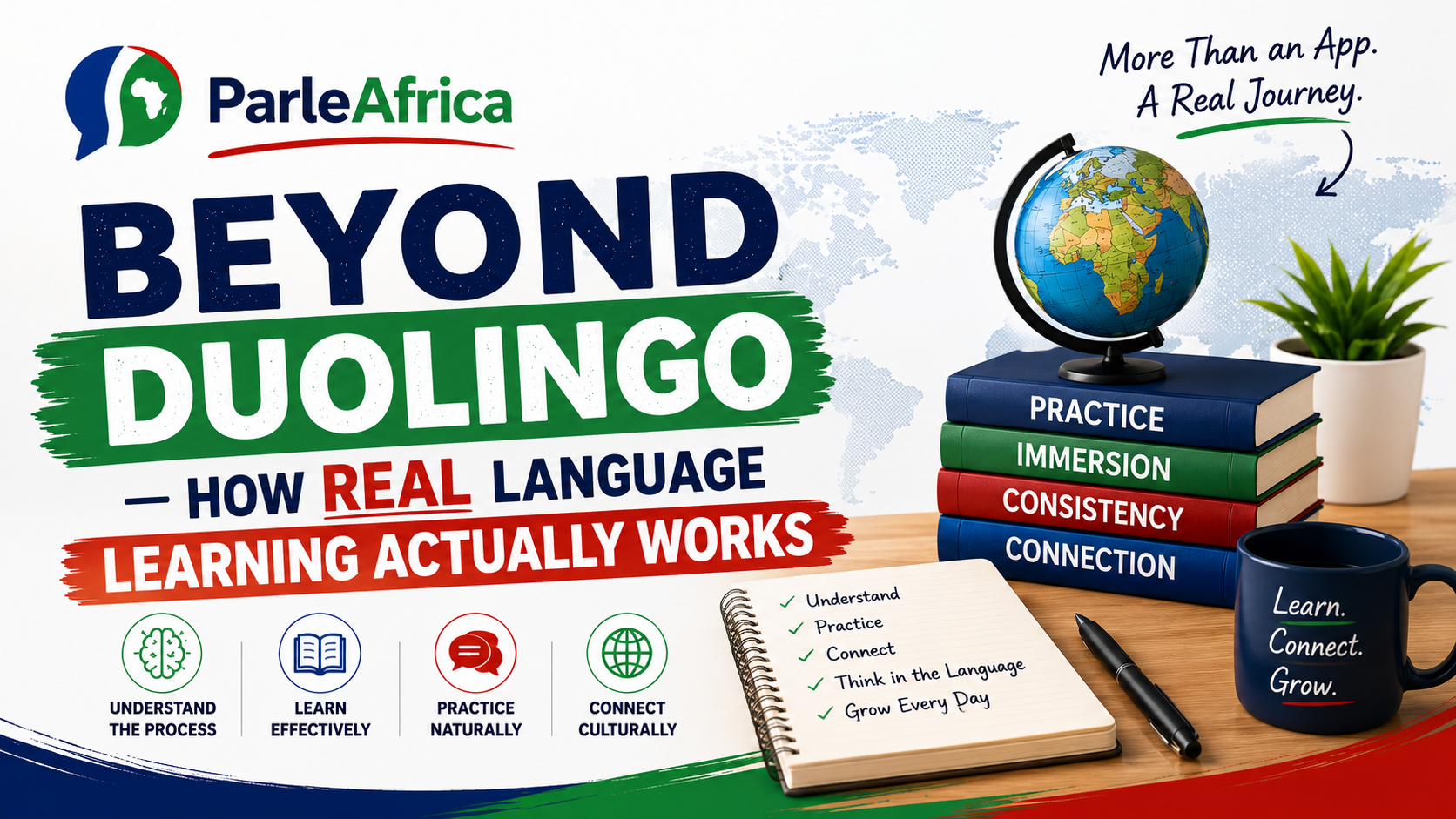
Beyond Duolingo — How Real Language Learning Actually Works
Duolingo is a great starting point. But if you want to actually speak French, you need to understand what real language acquisition looks like — and why apps alone will never get you there.

Let's be honest about Duolingo. It is beautifully designed. It is free. It is addictive in the best possible way. The little green owl is charming. The streaks are motivating. The gamification is genuinely clever. For millions of people around the world, Duolingo is the first place they ever heard a French word pronounced correctly, the first place they learned that "bonjour" means good morning, the first place language learning felt accessible rather than intimidating.
That is real. That matters. And we should not dismiss it.
But here is something Duolingo's marketing understandably doesn't emphasize: after years of using the app, the vast majority of its users cannot hold a real conversation in the language they have been "learning". They can translate sentences. They can match words to pictures. They can fill in blanks. But put them in front of a native speaker and ask them to talk — and the words don't come.
This is not a failure of the users. It is a fundamental limitation of the method. And understanding why that limitation exists is the first step toward actually becoming fluent.
What Duolingo Is Actually Good At
Before we go further, let's be fair. Duolingo does several things genuinely well, and dismissing it entirely would be dishonest.
It is excellent at building a daily habit. The streak mechanic — the idea that you must practice every day or lose your progress — is one of the most effective habit-formation tools in consumer technology. For a beginner who has never studied French before, that daily habit of even five minutes is genuinely valuable. Consistency, as we've said before, beats intensity every time.
It is also good at introducing vocabulary. Seeing a word, hearing it pronounced, and matching it to an image multiple times across multiple sessions does create memory traces. You will remember that "le chien" means dog. You will remember that "manger" means to eat. That foundational vocabulary is real and useful.
And it is good at lowering the psychological barrier to language learning. Many people who would never pick up a textbook will happily spend ten minutes on Duolingo. That entry point has genuine value. If Duolingo is what gets someone started, then Duolingo has done something important.
So yes — use Duolingo. Especially at the very beginning. But understand exactly what it is giving you, and exactly what it is not.
The Fundamental Problem: Duolingo Teaches Translation, Not Communication
Here is the core issue. Duolingo is, at its heart, a translation machine. It shows you an English sentence and asks you to produce the French equivalent. It shows you a French sentence and asks you to produce the English equivalent. The entire system is built around moving between two languages — and that is precisely the wrong mental model for fluency.
Fluent speakers do not translate. They do not hear a French sentence, convert it to English in their heads, formulate an English response, and then translate that response back into French. That process is far too slow for real conversation. Fluent speakers think directly in the language. They hear French and understand French. They want to express an idea and the French words come — not because they translated from English, but because the French is already there.
Duolingo, by design, trains the translation pathway. Every exercise reinforces the habit of moving between languages rather than thinking in one. After a year of Duolingo, you have built a very efficient translation machine in your brain. But a translation machine is not the same as a language. And when a native speaker talks to you at natural speed, your translation machine simply cannot keep up.
The Science of Language Acquisition
Linguist Stephen Krashen's Input Hypothesis, developed in the 1980s and still widely respected today, makes a simple but profound claim: we acquire language in one way and one way only — through comprehensible input. That means exposure to language that we mostly understand, with a small amount that stretches us just beyond our current level.
This is how every human being on earth learned their first language. Not through grammar drills. Not through translation exercises. Not through matching words to pictures. Through massive, sustained exposure to real language being used in real contexts — conversations, stories, songs, arguments, jokes — until the patterns became automatic.
Krashen distinguishes between language acquisition (the unconscious process of absorbing a language through exposure) and language learning (the conscious study of grammar rules and vocabulary lists). His argument — backed by decades of research — is that acquisition is what produces fluency, while learning alone produces only the ability to pass tests.
Duolingo is almost entirely in the "learning" category. It teaches you rules and vocabulary consciously. It does almost nothing to facilitate acquisition — the deep, unconscious absorption of language that comes from real exposure and real use.
What Duolingo Cannot Give You
Let's be specific about the gaps. These are the things that Duolingo structurally cannot provide, no matter how many lessons you complete or how long your streak is.
Real listening comprehension. Duolingo's audio is slow, clear, and perfectly enunciated. Real French speakers do not talk like that. They speak at natural speed, they swallow syllables, they use contractions and liaisons and regional accents. The gap between Duolingo audio and real spoken French is enormous — and it is a gap that only hours of real listening can close. Podcasts, films, music, conversations — these are the tools that build real listening comprehension. Duolingo cannot replicate them.
Spontaneous speaking. Duolingo never puts you in a situation where you have to produce language under pressure, in real time, without knowing what's coming next. Real conversation is unpredictable. Someone asks you something you didn't prepare for. You have to find the words, construct the sentence, and deliver it — all in a few seconds. That skill is built only through actual conversation. There is no shortcut and no app that can simulate it.
Cultural and contextual knowledge. Language is not just words and grammar. It is culture, context, tone, and relationship. Knowing that "tu" and "vous" both mean "you" is not the same as knowing when to use each one, and what the social consequences of getting it wrong are. Knowing that "on est ensemble" is a greeting is not the same as understanding the warmth and solidarity it carries in Cameroonian culture. This kind of knowledge comes from immersion in the culture — from real interactions with real people — not from an app.
Emotional connection to the language. This one is harder to quantify but perhaps the most important. Language learning is sustained by motivation, and motivation is sustained by emotional connection. When you have a real conversation in French — even a broken, imperfect one — and you are understood, something happens in your brain that no app can replicate. You feel the language working. You feel yourself becoming someone who speaks French. That feeling is what keeps people going through the hard months when progress feels slow. Duolingo's gamification, while genuinely clever, is a different kind of motivation from the real thing.
Note: This article reflects our pedagogical perspective on language acquisition methods. We have genuine respect for what Duolingo has built and recommend it as a starting point throughout this piece.
The Plateau Problem
Almost every Duolingo user hits the same wall. They complete the beginner content. They feel good about their progress. They start the intermediate content. And then — nothing. The lessons get harder, the vocabulary gets more obscure, but the ability to actually communicate doesn't improve. They are learning more words but not getting more fluent. They are spending more time on the app but not getting closer to real conversation.
This is the Duolingo plateau, and it is almost universal. It happens because the method that works for absolute beginners — structured, gamified, translation-based exercises — stops working once you have the basics. At that point, what you need is not more exercises. What you need is real language use. And Duolingo cannot give you that.
Many learners at this stage conclude that they are simply not good at languages. They blame themselves. They give up. But the problem was never their ability. The problem was the tool. They needed to graduate from Duolingo to something more powerful, and nobody told them that was the next step.
What Real Language Learning Looks Like
So if Duolingo is not enough, what is? The research and the experience of successful language learners point to the same answer: a combination of comprehensible input, real output, and genuine community.
Comprehensible input at scale. This means hours of listening to and reading French that you mostly understand. Not studying French — consuming it. Films with French subtitles. Podcasts at your level. News in French. Music in French. The goal is to flood your brain with real language until the patterns become automatic. This is how children learn languages, and it is how adults learn them too when they do it right.
Real conversation, from as early as possible. The fear of speaking before you're "ready" is one of the biggest obstacles in language learning. There is no ready. There is only speaking badly and then speaking less badly. Every conversation you have in French — no matter how broken — is building the neural pathways that will eventually produce fluency. Find a language partner. Join a community. Speak. Make mistakes. Speak again.
Structured learning that serves communication. Grammar and vocabulary study are not useless — they are just insufficient on their own. The key is to study grammar in service of communication, not as an end in itself. Learn a structure because you want to use it in conversation, not because it appears in the next lesson. This kind of purposeful, contextualised learning sticks far better than abstract drills.
Community and accountability. Language learning is a long game. It takes months and years, not days and weeks. The learners who make it are the ones who have people around them — other learners, native speakers, teachers, friends — who keep them going when motivation dips. Community is not a nice-to-have. It is a core component of successful language acquisition.
The African Context: Why This Matters Even More
For Africans learning French specifically, the limitations of app-based learning are even more pronounced. Duolingo teaches European French — the French of Paris, of formal registers, of textbook sentences. It does not teach the French of Abidjan, of Kinshasa, of Dakar, of Douala. It does not teach Nouchi. It does not teach "on est ensemble" or "tu vas comment" or "on fait aller". It does not prepare you for the speed and musicality of Congolese French or the warmth and expressiveness of Senegalese French.
If your goal is to connect with Francophone Africans — to do business across the continent, to travel, to build relationships, to participate in the pan-African conversation — then you need to learn African French. And African French is learned from Africans, in African contexts, through African communities. No app built in San Francisco can give you that.
This is not a small gap. It is the difference between being able to order food in a Parisian restaurant and being able to negotiate a deal in Abidjan, navigate a market in Dakar, or build genuine friendships in Kinshasa. The French that matters for African ambitions is African French — and that requires African learning environments.
Where ParleAfrica Fits In
ParleAfrica was built precisely for this gap. Not as a replacement for the discipline of structured learning, but as the environment where that learning becomes real.
The community on ParleAfrica is made up of Africans at every level of French — complete beginners posting their first sentences, intermediate learners asking questions about grammar, advanced speakers helping others and practicing their own fluency. The conversations happen in English, Pidgin, and French — because that is how Africans actually communicate. The lessons are grounded in African contexts, African vocabulary, and African culture.
When you post in French on ParleAfrica and someone responds, corrects you gently, and encourages you — that is real language use. When you read someone else's post and understand it — that is comprehensible input. When you ask a question about a phrase you heard in a Congolese song and three people explain it to you — that is cultural immersion. These are the things that build real fluency, and they cannot happen on Duolingo.
The path we recommend is not either/or. Use Duolingo to build your initial vocabulary and daily habit. Use ParleAfrica's structured lessons to understand grammar in context. Use the ParleAfrica community to practice real communication, get feedback, and stay motivated. Use French media — music, films, podcasts — to flood your brain with real input. And keep going, even when it's hard, even when progress feels slow, even when you make mistakes.
The Honest Truth About Fluency
Fluency is not a destination you arrive at after completing enough lessons. It is a capacity that develops gradually through thousands of hours of real language use. There is no app, no course, no method that can shortcut that process. Anyone who tells you otherwise is selling something.
What you can do is make those hours as effective as possible. You can choose methods that build real acquisition rather than just test performance. You can surround yourself with the language and the community. You can speak before you feel ready. You can embrace the discomfort of not understanding everything and trust that comprehension will come with time.
The learners who become fluent are not the ones with the most talent or the most time. They are the ones who understood what real language learning requires — and committed to it, consistently, over the long term.
Duolingo can start that journey. But it cannot finish it. The rest of the work happens in the real world — in conversations, in communities, in the messy, beautiful, irreplaceable experience of actually using a language with real people.
That is what ParleAfrica is here for. Come and do the real work with us.
Did you enjoy this article?
Tap ❤️ to like or 🔥 to superlike
More articles

Practice what you just learned
Join the ParleAfrica community and speak French with real Africans.
Join for free